
At IDEA Public Schools, we are committed to supporting the whole child — academically, socially, emotionally, and behaviorally. Our mental health services are designed to help students and families thrive in school and beyond through proactive, strengths-based supports and partnerships.
IDEA uses a Multi-Tiered System of Supports (MTSS) framework to meet students’ emotional and mental health needs through a continuum of care:
IDEA Public Schools partners with families to support student mental health and well-being.
In accordance with Texas Senate Bill 12 (SB 12):
These are classroom and school-wide supports available to all students. They include:
For students who need additional assistance:
Per SB 12 guidelines, parent/guardian consent is required for student participation.
For students with more significant emotional or behavioral needs:
At IDEA Public Schools, we are committed to supporting the whole child through a multi-tiered system of support that addresses students’ emotional, behavioral, and mental health needs. In addition to our proactive and preventative programming through Move This World, we also offer more targeted supports based on student need.
Some students benefit from additional support through small group counseling. These groups are facilitated by trained, licensed mental health professionals and focus on skills such as:
In alignment with Texas SB 12, written parent/guardian consent is required before a student participates in any small group mental health services.
Parents and guardians may also request small group support for their child by contacting their campus counselor or social worker.
For students experiencing more intensive emotional or behavioral concerns, IDEA offers individualized mental health services provided by licensed campus-based professionals.
Services are:
In accordance with Texas SB 12, written parent/guardian consent is required prior to the start of individual counseling services.
Parents/guardians may also refer their child for services at any time.
Our goal is to ensure students receive the right level of support in a safe, supportive school environment — always in partnership with families.
If you believe your child would benefit from additional support, we welcome you to submit a referral.
This form allows you to share your concerns directly with our mental health team so we can determine the best way to support your child. Upon receiving the referral, the campus mental health provider will reach out to you for additional information to discuss your child’s needs further to support them within the school environment.
Together, we can ensure every student feels safe, supported, and ready to learn.
Our vision is to ensure the physical and emotional safety of all IDEA staff and students. By providing high-quality training and professional development to team members and preventative psycho-educational lessons to students, we optimize the level of preparedness for our staff, students, and community in the event of a crisis or critical incident.
At IDEA, we believe equipping campus administrators, teachers, students, and families with the skills to prevent, identify, and respond to crises and critical incidents provides campuses with the best opportunity to remain safe for all. While we can’t prevent all crises from occurring, we can ensure that when they do, everyone is aware of their role and prepared to respond using a trauma-informed approach. We also believe that effective communication with staff, students, and families is paramount. We promise to keep all stakeholders abreast whenever incidents occur, as well as provide updates and closure while we work to resolve the situation.
Take a moment to review the list of curated resources for family members to support their student(s) during vulnerable times in their lives and those close to them. Additional resources are added periodically, so be sure to visit our page regularly.
Resources:
Tier 1 Proactive and Preventative Mental Health Skills are processes through which children and adults acquire and apply the skills necessary to understand and manage emotions, set and achieve goals, feel and show empathy for others, establish and maintain positive relationships, and make responsible decisions. The initiatives we have selected will continue to contribute to a strong school culture in which all students feel safe, supported, and valued.
Proactive and preventative mental health programming is a process through which children and adults acquire and apply the skills necessary to understand and manage emotions, set and achieve goals, feel and show empathy for others, establish and maintain positive relationships, and make responsible decisions. The initiatives we have selected will continue to contribute to a strong school culture in which all students feel safe, supported, and valued.
At IDEA Public Schools, we use Move This World as the foundation of our proactive and preventative mental health program. Move This World uses fun and engaging videos to teach core emotional and behavioral skills, helping your child develop the confidence to express their feelings authentically, manage emotions in healthy ways, and navigate challenges successfully from Kindergarten through 12th grade.
This year, we will continue to use Move This World as our foundational proactive and preventative mental health program. Move This World uses fun and engaging videos to support students in developing essential skills such as responsible decision-making, relationship building, emotional regulation, self-awareness, and empathy. Through consistent use of this program, students are empowered to express their feelings authentically, manage emotions in healthy ways, and navigate everyday challenges with confidence.
At IDEA Public Schools, we are committed to supporting your child’s proactive and preventative mental health development each day in the classroom. Students will begin their mornings by watching and engaging with short, interactive videos designed to build essential life skills such as self-awareness, emotional regulation, empathy, relationship-building, and responsible decision-making.
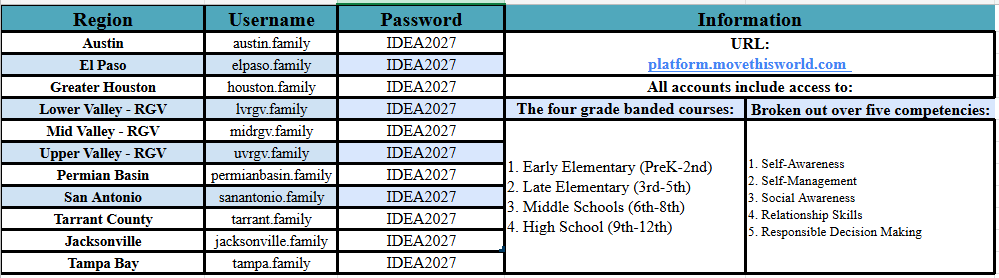
Move This World provides engaging, developmentally appropriate videos that use movement, creativity, and self-expression to help students, educators, and families strengthen emotional intelligence and promote long-term wellbeing. As families, you can access and use the program at home too! Simply log in, type in the region your child attends using the log in information below, choose the curriculum for your child’s grade level, and begin exploring Move This World together.
The mood meter is a tool that we use to support our students in identifying and expressing their emotions. We believe that when students are able to identify emotions, they can then learn to manage them. In class each day (virtual or in-person), your child will have an opportunity to share with their teacher and classmates how they feel using the mood meter.
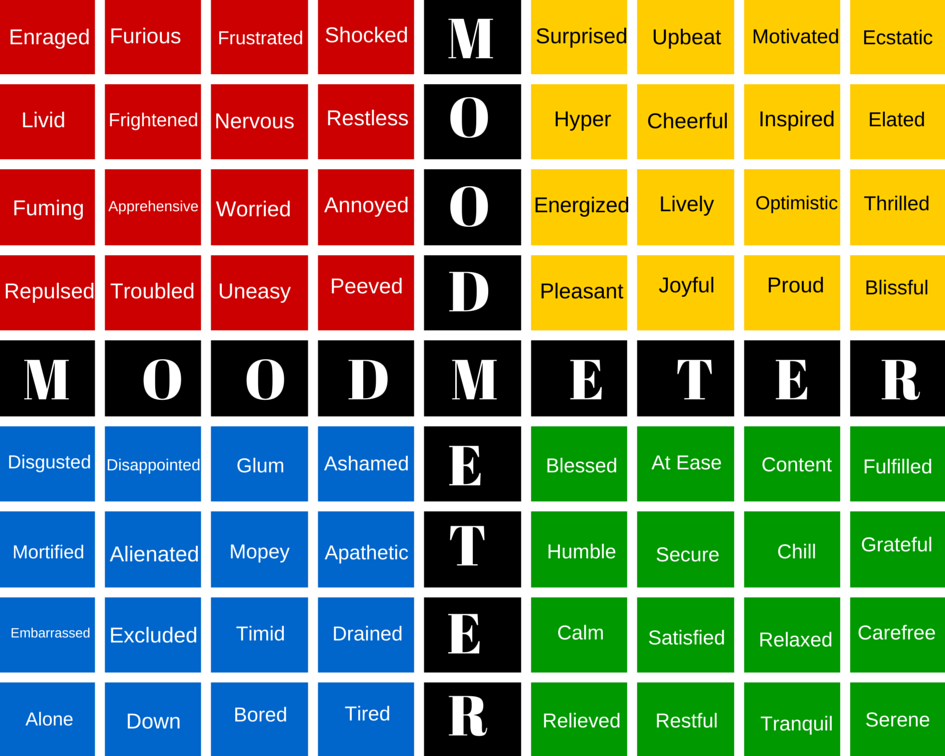
The Mood Meter consists of four colors: red, blue, green, and yellow. Each Mood Meter color represents a different set of feelings associated with the pleasantness of the emotion and the energy it has.
You can reinforce what your child is sharing at school by using the mood meter at home.
Aside from compliance, IDEA believes in educating students on how to identify warning signs, support peers & seek the appropriate support is essential to living up to our organizational goal of College & Beyond for All. Empowering students to take these matters seriously builds community and leadership skills while ensuring the safety of peers and school. Students become a contributing stakeholder in how their peers thrive academically, socially, and emotionally. This shifts a campuses culture and improves the learning environment for not only students, but staff, administrators, and families—who ultimately decide if their child persists with us year after year.
The Lauren’s Kids Safer, Smarter Schools curriculum is the country’s first Pre-Kindergarten through grade 12 school-based prevention and personal safety curriculum series. It was developed by the Lauren’s Kids Foundation, career educators, and developmental psychologists to educate children, teachers, and parents. The curriculum contains educationally sound and developmentally appropriate content for children, parents, teachers, and administrators, aligned to state and national education standards.
The Safer, Smarter Kids program spans Pre-Kindergarten through grade 5, as well as special education; Safer, Smarter Teens provides lessons for middle and high school students. Safer, Smarter Schools professional development is also available for educators, administrators and guidance professionals. The Safer, Smarter Schools curriculum also fulfils Erin’s Law child sexual abuse prevention program requirements.
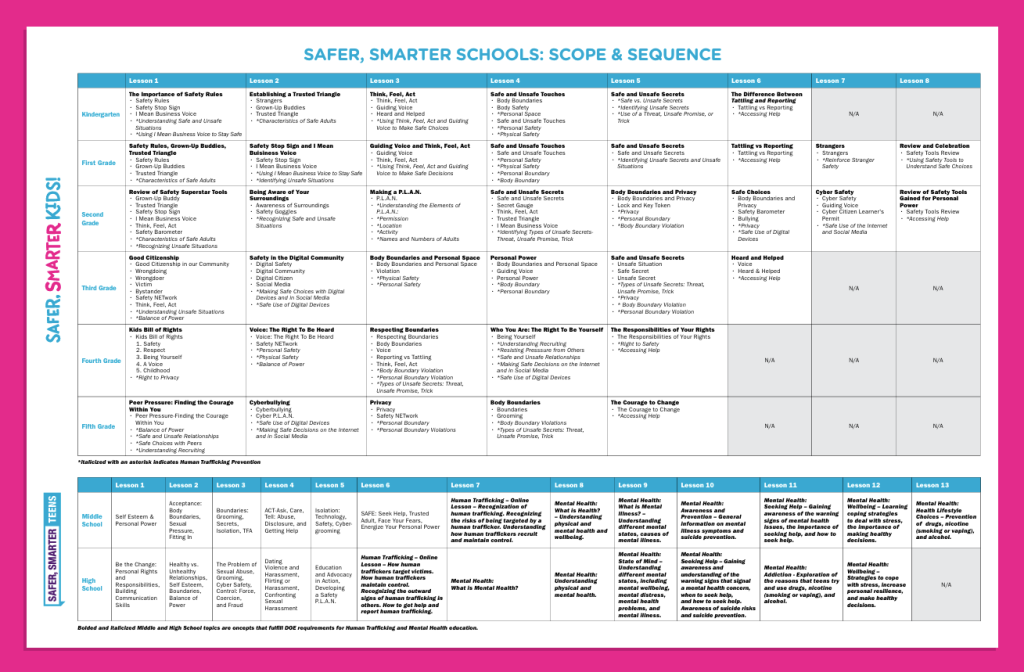
Each Lesson Includes: